Lawmakers Warn Department of Education
Student Loan Restrictions Will Devastate Access to Mental Health Care
Mental
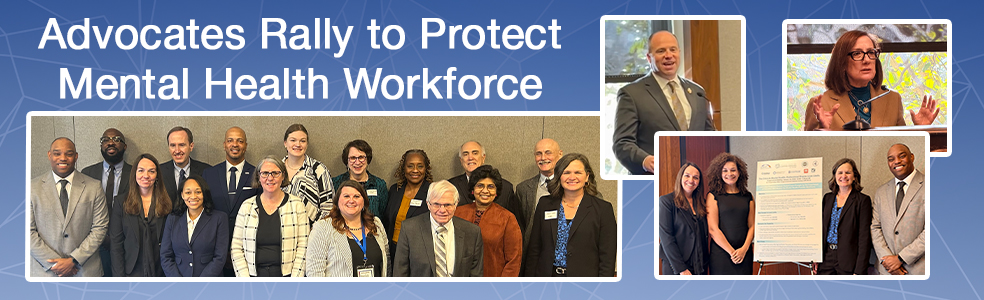
health advocates, Professional Counseling organizations, and bipartisan members
of Congress gathered on Capitol Hill to raise awareness of economic and access
to care risks posed by proposed policy changes in Department of Education (ED) professional
degree recognition and federal financial aid access. The proposed Department of
Education policies threaten the Mental Health
Counseling workforce at the worst possible time—during an unprecedented
national mental health crisis.
The
briefing, titled “The Crisis in Mental Health: Professional Degree Loan
Limits,” was sponsored by Congresswoman Andrea Salinas (D-OR), Co-Chair of
the Congressional Mental Health Caucus, hosted by NBCC, and brought together
leadership from nine national Counseling, Social Work, and Marriage and Family Therapy
organizations representing hundreds of thousands of mental health providers
nationwide.
Department
of Education Proposed Policy Threatens Access to Care and Workforce Capacity
The
Department of Education’s proposed reclassification of Counseling, Social Work,
and Marriage and Family Therapy programs as “graduate” rather than “professional”
degrees will create insurmountable financial barriers for students seeking to
enter these critical professions.
Kylie
Dotson-Blake, President and CEO of the National Board for Certified Counselors
(NBCC), opened the
briefing by framing the stakes clearly: “At its core, this issue is about
whether future mental health providers can afford to enter the professions. At a time when, across the country, we are seeing the
highest levels of need for mental health services we have ever seen, our
country cannot afford to dramatically reduce the workforce and access to
professional care.”
Under
the proposed rule, Counseling students will face:
- reduced
federal loan limits,
from $50,000 to $20,500 annually.
- elimination
of Graduate PLUS loans
starting July 1, 2026.
- forced
reliance on private loans
with interest rates of 8%–14% and no consumer protections.
- debt-to-income ratios that make Counseling careers financially unsustainable.
Dr.
Dotson-Blake emphasized the arbitrary nature of the exclusion: “Counselors are
already recognized as professional providers by Medicare, Medicaid, TRICARE,
the VA, and Indian Health Service. The Department of Education is the outlier
here.”
The
Workforce Reality: America Cannot Afford to Lose More Counselors
The
briefing highlighted the severe mental health provider shortage already
gripping the nation:
- Over
137 million Americans
live in federally designated Mental Health Professional Shortage Areas.
- 65%
of rural counties
have no psychiatrists.
- Nearly
half of rural counties
have no psychologists.
- In many communities, Counselors are the primary—or only—mental health providers available.
“If
we make it harder for students to become Counselors, we are actively shrinking
the workforce pathway at the worst possible time,” Dr. Dotson-Blake warned. “When
Counselors aren't around, access collapses.”
She
noted that Counselors are often the most affordable mental health providers and
are more likely to accept Medicaid and Medicare; practice in community settings;
offer sliding-scale fees; and serve children, families, veterans, and older
adults. “Fewer Counselors means longer wait times, higher costs, more untreated
mental illness, and more people ending up in emergency rooms or the criminal
justice system.”
The
Equity Dimension: Who Gets Priced Out of Helping Professions?
The
briefing emphasized that the proposed policy does not affect students equally.
Students from low-income backgrounds, first-generation college students, and
those from underrepresented communities—who rely most heavily on federal
loans—will face the greatest barriers.
“Those also are the students most likely to
return to rural communities and other underrepresented communities to practice—bringing
their contributions to the tax base, local spending and personal community
investments—in ADDITION to broadening access to care,” Dr. Dotson-Blake explained. “So, when
Department of Education reduces access to federal student loans, it doesn't
just reduce the workforce—it reduces access to care where it's needed most.”
The
policy threatens to make Counseling careers accessible only to students from
wealthy families who can subsidize education costs—fundamentally changing who
can become a Counselor.
Bipartisan
Congressional Support
Congresswoman
Andrea Salinas (D-OR),
Co-Chair of the Congressional Mental Health Caucus and a first-generation
college student herself, emphasized her personal understanding of how
professional pathways make a difference for families and communities.
Congresswoman
Salinas stressed the urgency of the workforce crisis facing America’s
mental health system. “The United States is in the midst of a mental health
crisis, and we currently do not have enough providers to meet the needs of our
communities,” Rep. Salinas stated. “More than 163 million Americans currently
live in Mental Health Professional Shortage areas, and by 2037, we’re projected
to face a shortage of over 400,000 mental, behavioral, and addiction treatment
providers.”
Rep.
Salinas, who has led 25 of her congressional colleagues in urging ED to reverse
course, warned of the direct consequences of excluding mental health
professions from professional degree status.
“Excluding
graduate degrees in Social Work, Mental Health Counseling, Addiction Counseling,
Marriage and Family Therapy, Nursing, and School Counseling from the ‘professional
degree’ category will limit access to loans and funding for students pursuing
these vital careers,” she explained. “This will only exacerbate workforce
shortages and wait times for people desperately seeking mental and behavioral
health services.”
As
a first-generation college student who understands how professional pathways
make a difference for families and communities, Rep. Salinas emphasized that
the Department's decision reflects a fundamental misunderstanding of how mental
health care is delivered in America today.
“We
believe it is essential that mental health, behavioral health, and substance
use disorder professionals be recognized alongside other health professionals,”
Rep. Salinas said. “Communities across the nation depend on these providers for
timely, quality mental and behavioral health care services. We cannot afford
policies that make it harder for qualified professionals to enter and remain in
this workforce.”
Rep.
Salinas called on ED and the Reimagining and Improving Student Education (RISE)
Committee to “reconsider the classification of mental and behavioral health
graduate programs, recognizing them as professional degree programs and
essential health and human services pathways.”
Congressman
Tim Kennedy (D-NY), a
licensed Occupational Therapist with a master's degree who spent 11 years
working with geriatric and pediatric patients, brought the perspective of a
health care practitioner who understands licensure requirements and clinical
training.
Rep.
Kennedy warned, “These new loan restrictions will severely hinder the ability
of prospective health care professionals to finance their education and enter
the field, further destabilizing a health care system already in crisis. These
loan limits will worsen staff shortages, restrict access to higher education,
and further strain a health care system already at its breaking point.” Rep. Kennedy
underscored these concerns citing deepening staff shortages, clinic closures,
and communities increasingly being left without access to timely care.
“When
I went to grad school to become an OT, I had to take out loans. I remember
filling out those forms, hoping I’d have enough to cover tuition, books, and
rent,” said Congressman Kennedy. “I remember the weight of those payments
followed me for years. I took on that debt because I wanted to build a better
future for my family and because I wanted to help people. This administration
wants to force aspiring health care professionals to mortgage their futures
before they treat their first patient. Worse, this move will deter them from
answering their calling, taking an axe to the very system that trains them,” Rep.
Kennedy said.
The
briefing also featured powerful testimony from practicing mental health providers
and current students who provided firsthand accounts of how adequate federal
loan access made their careers possible—and how the proposed changes would
devastate future generations of providers. Practitioners described the
financial challenges they navigated to complete their training, emphasizing
that without Graduate PLUS loans and reasonable federal borrowing limits, they
would never have been able to afford the education required to serve their
communities.
Current
students shared the stark reality of trying to finance graduate programs that
cost $50,000–$80,000 while completing hundreds of hours of unpaid clinical
internships, warning that the proposed $20,500 annual loan cap would force them
and their peers to abandon mental health careers, despite the desperate
community need for mental health services.
The
Educational Rigor: Counseling IS Professional Education
The
briefing underscored that Counseling programs meet every criterion of
professional education:
- rigorous
accreditation by
the Council for Accreditation of Counseling and Related Educational
Programs (CACREP)
- more than
60 graduate credit hours
of specialized curriculum
- 2,000–3,000
hours of supervised clinical practice providing direct services to real clients
- state
licensure required in all 50 states and DC for independent practice
- passage
of national examinations
(National Counselor Examination, National Clinical Mental Health
Counseling Examination)
- terminal master's degree for full scope of professional practice
“Most
programs require 60 graduate credit hours or more, thousands of supervised
clinical hours, and passage of national examinations,” Dr. Dotson-Blake stated.
“The Department of Education’s exclusion is arbitrary and inconsistent with how
they treat other professions with equivalent training.”
A
United Front: Nine National Organizations Stand Together
The
briefing demonstrated unprecedented unity across the Counseling, Social Work,
and Marriage and Family Therapy professions. Participating organizations
included:
- American
Association for Marriage and Family Therapy (AAMFT)
- American
Counseling Association (ACA)
- American
Mental Health Counselors Association (AMHCA)
- Association
for Counselor Education and Supervision (ACES)
- Clinical
Social Work Association (CSWA)
- Council
for Accreditation of Counseling and Related Educational Programs (CACREP)
- National
Association of Social Workers (NASW)
- National Board for Certified Counselors (NBCC)
“This
level of alignment across organizations reflects how serious and urgent this
issue is,” Dr. Dotson-Blake emphasized.
The
Ask: Congressional Action Needed
The
briefing concluded with three clear calls to action for members of Congress:
- Urge
the Department of Education to immediately restore Counseling, Social Work,
and Marriage and Family Therapy to professional degree status in the final rule.
- Conduct
oversight of ED’s decision
and, if necessary, support legislative or appropriations strategies to
update the professional program definition ahead of the July 1, 2026,
implementation date.
- Protect
the mental health workforce pathway and access to care, particularly in rural and
high-need communities.
What's
Next
The
public comment period for the ED proposed rule remains open, and mental health
organizations are mobilizing practitioners, students, educators, and community
members to submit comments opposing the exclusion of the Counseling profession
from professional degree status. Take action by March 2 to make your voice hear
on this important issue! https://www.votervoice.net/NBCCGrassroots/campaigns/133650/respond
Several
legislative proposals have also been introduced to address the crisis, ranging
from complete reversal of the loan restrictions (H.R. 6677, Professional Degree
Access Restoration Act) to explicit statutory recognition of Counseling and
related professions as professional degrees (H.R. 6718, Professional Student
Degree Act).
“Professional
degree status is NOT symbolic—it directly determines who can afford to enter
the profession and ultimately impacts access to care,” Dr. Dotson-Blake
concluded. “The Department of Education’s proposed policy undermines federal
investments in the mental health profession and may cause workforce pathways,
especially in rural and high-need communities, to collapse.”
“The
bottom line is simple,” she added. “We are already in a mental health workforce
crisis. We cannot solve it by making it financially impossible for students to
become Professional Counselors.”


